Tuesday, September 7, 2010

Data Recovery

Data Recovery basically means getting back the lost and inaccessible data. Generally, the data gets corrupt due to natural disasters, human errors, software errors, hardware failures and virus attacks. In most cases, the majority of data is recoverable either through data recovery software or through the services provided through Class 100 Clean room facilities. Around 50% of data loss is caused by hardware failure. It’s important to make sure that you immediately shut down your system if you suspect that hard drive has corrupted.

Nucleus Data Recovery, the leader in Data Recovery Software and File Recovery Software provides result-oriented, cost-effective, fast and secure tools and services to retrieve back your lost data. Our KernelTM software tools - do-it-yourself utilities are unmatched amongst the number of Data Recovery software tool present in the market. With years of experience in this field we have accomplished the position with hard work, commitment and establishing ourselves amongst the best hard disk data recovery software and service providers through 99% client satisfaction score.

Kernel data recovery software provide a complete range of data recovery software tool for Hard Drive Recovery, Hard Disk Recovery, Disk Recovery, Windows Data Recovery, Linux Data recovery, Mac Data recovery, Novell Netware Data Recovery, Unix Data Recovery etc. Kernel Data Recovery is Best Hard Disk Recovery software & database recovery products, for repairing damaged files or corrupt files data which get lost due to bad sector, file corruption, virus attack, accidentally deleted file etc. Our File Repair Software provides complete solution for common problems

  KernelTM Data Recovery range of Best Selling data recovery software, hard disk recovery  software, database recovery &  file repair products, for recovering deleted files or corrupt files data which get lost due to bad sector, file corruption, virus attack, accidentally deleted file etc.

We are also equipped with advanced file repair utilities software for corrupt access database repair, MS backup recovery, corrupt zip repair, corrupt excel file recovery, corrupt word document recovery.

KernelTM Data Recovery Tools - designed data recovery software and hard disk data recovery software to recover data from the Windows (FAT16, FAT32, NTFS, NTFS5), Linux (Ext2, Ext3, JFS, ReiserFS), UNIX (UFS, EAFS, HTFS, VxFS, FFS), Novell Netware (NWFS, Net386, NSS) and Apple Macintosh file systems. Our proprietary QFSCI (Quick File System Component Identification) technology helps to quickly recover data from the damaged drives and promises accurate and secure data recovery.

Data Recovery - Kernel Hard Disk Data Recovery Software provides a best range of Windows recovery, Linux Recovery, Macintosh Recovery, Novell Recovery, Unix Recovery and Digital Photo Recovery.

File Recovery - Kernel File Repair Software provides a best range of Access Recovery, Word File Recovery, Excel Recovery, PowerPoint Recovery and Publisher Data Recovery.

Email Recovery - Kernel Email Recovery Software provides a best range of Outlook Express Recovery, OST Recovery, PST Recovery, Incredimail Recovery, Exchange Server Recovery, NSF to PST Conversion, Convert GroupWise to Outlook, Convert Notes Contacts to Outlook, Convert Notes Calendar to Outlook Convert Outlook to Notes and Outlook Express to Notes.

Password Recovery - Kernel Password Recovery Software provides a best range of Access Password Recovery, VBA Password Recovery and Outlook Password Recovery.

Database Recovery - Kernel Database Recovery Software provides a best range of Access Database Recovery, DBF Recovery, Paradox Database Recovery and SQL Database Recovery.

Backup Recovery - Kernel Backup Recovery Software provides a best range of BKF Repair, Zip Repair and Tape Recovery.

The Achievements, Experience and Client satisfaction percentile makes Nucleus Data Recovery stand amongst the excellent data recovery solution providers. We have constantly worked upon to promote data safe world ensuring recovery of every bit of lost data.

Laser Shutter


Seems like there is no end to the uses of old hard drive This hack uses the
voice coil of a used hard drive to act as a Laser Shutter. Thanks for the tip Robo.

“We have developed a high-speed laser shutter based on voice-coil actuators found in generic hard disk drives. We have enhanced the shutter with a new driver circuit described below and a notched flag, achieving 500ns rise time and sub-microsecond pulse durations. The shutter is readily constructed from a disassembled hard drive (as shown in an early prototype in the photo above), with the addition of a simple drive circuit. A high-current opamp (e.g. L165V or OPA548) can be used, but requires a bipolar power supply, and generally some sort of pulse shaping. The circuit in our paper, designed by Sandor Szilagyi, provides very fast switching, a small holding current, and bidirectional drive from a unipolar supply.”

Construction of a Hard Disk

Construction of a Hard Disk (Hard Drive)

Hard disks are rigid platters, composed of a substrate and a magnetic medium. The substrate - the platter's base material - must be non-magnetic and capable of being machined to a smooth finish. It is made either of aluminium alloy or a mixture of glass and ceramic. To allow data storage, both sides of each platter are coated with a magnetic medium - formerly magnetic oxide, but now, almost exclusively, a layer of metal called a thin-film medium. This stores data in magnetic patterns, with each platter capable of storing a billion or so bits per square inch (bpsi) of platter surface.

Platters vary in size and hard disk drives come in two form factors, 5.25in or 3.5in. The trend is towards glass technology since this has the better heat resistance properties and allows platters to be made thinner than aluminium ones. The inside of a hard disk drive must be kept as dust-free as the factory where it was built. To eliminate internal contamination, air pressure is equalised via special filters and the platters are hermetically sealed in a case with the interior kept in a partial vacuum. This sealed chamber is often referred to as the head disk assembly (HDA).

advertisement
Spotmau PowerSuite - Complete Computer Solution
Geometry

Typically two, three or more platters are stacked on top of each other with a common spindle that turns the whole assembly at several thousand revolutions per minute. There's a gap between the platters, making room for magnetic read/write head, mounted on the end of an actuator arm. This is so close to the platters that it's only the rush of air pulled round by the rotation of the platters that keeps the head away from the surface of the disk - it flies a fraction of a millimetre above the disk. On early hard disk drives this distance was around 0.2mm. In modern-day drives this has been reduced to 0.07mm or less. A small particle of dirt could cause a head to "crash", touching the disk and scraping off the magnetic coating. On IDE and SCSI drives the disk controller is part of the drive itself.

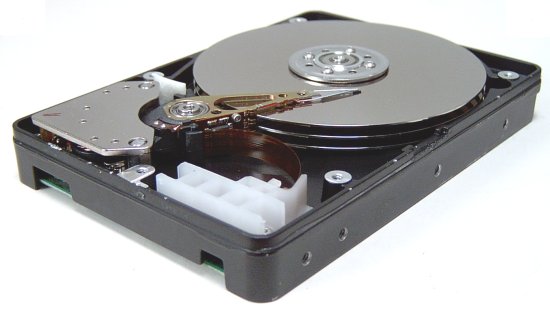
There's a read/write head for each side of each platter, mounted on arms which can move them towards the central spindle or towards the edge. The arms are moved by the head actuator, which contains a voice-coil - an electromagnetic coil that can move a magnet very rapidly. Loudspeaker cones are vibrated using a similar mechanism.
HDD Head

The heads are designed to touch the platters when the disk stops spinning - that is, when the drive is powered off. During the spin-down period, the airflow diminishes until it stops completely, when the head lands gently on the platter surface - to a dedicated spot called the landing zone (LZ). The LZ is dedicated to providing a parking spot for the read/write heads, and never contains data.


Hard disks are rigid platters, composed of a substrate and a magnetic medium. The substrate - the platter's base material - must be non-magnetic and capable of being machined to a smooth finish. It is made either of aluminium alloy or a mixture of glass and ceramic. To allow data storage, both sides of each platter are coated with a magnetic medium - formerly magnetic oxide, but now, almost exclusively, a layer of metal called a thin-film medium. This stores data in magnetic patterns, with each platter capable of storing a billion or so bits per square inch (bpsi) of platter surface.
Hard Disk Drive
Platters vary in size and hard disk drives come in two form factors, 5.25in or 3.5in. The trend is towards glass technology since this has the better heat resistance properties and allows platters to be made thinner than aluminium ones. The inside of a hard disk drive must be kept as dust-free as the factory where it was built. To eliminate internal contamination, air pressure is equalised via special filters and the platters are hermetically sealed in a case with the interior kept in a partial vacuum. This sealed chamber is often referred to as the head disk assembly

Parts of a Hard Disk

Hard Disk
A hard disk drive contains rigid disk shaped platters, usually constructed of aluminum or glass which cannot be bent like floppy disc hence termed as hard disk. Since the platters cannot be removed they are sometimes called fixed disk drives.
The physical constructions of the hard disks contains of spinning disks with the heads that move over.
The physical construction of a hard disks called platters with heads, they are that move over the disk stacked on top of each other and spin at same speed, each with two sides tracks and sectors which the drive stores data. The heads read and write data in tracks which are divided up into segment called sectors. Most drives have at least 2-3 platters, resulting four or six sides, some driver have up to 11 or more platters. The identically positioned tracks on each side of every platter together make up a cylinder. A hard disk drive normally has one head per platter with all heads mounted on common rack. The hard disk spins the disk as 3600, 5400, and up to 7200 or even more RPM (rotation per minute).
Basic Hard drive components:
  • Disk platters
  • Read/ write head
  • Spindle motor
  • Head acutator mechanism
  • Logic board
  • Cable and connectors
  • Configuration items
The platters, spindle motor, heads and head actuator mechanism are contained in a sealed chambers called the Head Disk Assembly (HDA), usually treated as a single components and is rarely opened. Other parts external to HDA such as the logic board, cover, and other configuration items can be disassembled from the drive.